
LED Face Mask vs Red Light Panel: Which Should You Buy?
An LED face mask and a red light panel can both fit an at-home light routine, but they solve different practical problems. A mask is worn close to the face and prioritises convenience. A panel stays at a distance and can be aimed at the face, neck or other areas. The right purchase depends less on which format sounds more powerful and more on the area you want to cover, the light modes you need, the setup you will repeat and the device-specific instructions you can follow.
The short answer
Choose an LED face mask if: your priority is a hands-free, portable facial skin-care routine with a consistent close fit.
Choose a red light panel if: you want to position red and near-infrared light at the face and several other body areas without wearing a device.
There is no universal winner: a panel is not automatically better because it has more watts, and a mask is not automatically more effective because it sits closer. Dose, geometry, wavelength, session time and actual use all matter.
LED face mask vs panel at a glance
| Decision factor | MARS100 | MARS 400 |
|---|---|---|
| Main use | Hands-free facial routine | Face, neck and flexible targeted areas |
| Position | Worn directly on the face | Placed at the manual’s stated distance |
| Light options | Blue, amber, red and near-infrared | Red 660 and NIR 850 nm |
| Session | Follow the supplied manual | Automatic 10-minute cycle |
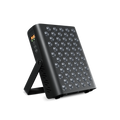
| Portability | Wireless, hands-free facial use | Mains-powered, 2.6 kg tabletop panel |
What is the real difference between a mask and a panel?
The main difference is geometry. A face mask holds its LEDs at a short, fairly repeatable distance from facial skin. That makes setup simple, but the shape fixes the treatment area. A panel does not touch the skin. You choose the distance and angle, which gives you more freedom but also makes positioning part of the routine.
Device format alone does not determine the result. Two masks can use different wavelengths, irradiance, timing and LED layouts; the same is true of two panels. Compare named specifications and instructions rather than treating every mask or every panel as one identical category.
Coverage and routine: convenience versus flexibility
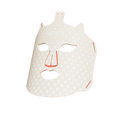
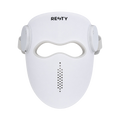
A mask is the simpler option when the face is the only priority. Strap it on, select a mode and keep to the timer. The MARS100 is wireless, so there is no separate tabletop controller or loose power cable during a session. The trade-off is obvious: its light pattern is designed around the face.
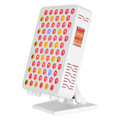
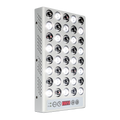
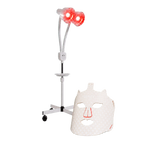
The MARS 400 takes more space and needs a stable position, but it can be aimed at the face, neck, shoulder or another smaller area. That flexibility is useful if several people or several body areas will share one device. It also means you must reproduce the manual’s distance and angle rather than moving closer simply because stronger light feels preferable.
Wavelengths and modes are not the same
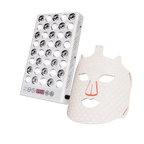
MARS100 offers 68 LEDs and three preset programs that combine blue, amber, red and near-infrared light. The current product information describes a wireless mask for cosmetic facial skincare. Use the supplied manual for the exact session length, frequency and mode selection.

MARS 400 is simpler: 660 nm red, 850 nm near-infrared or both together. It does not offer blue or amber light. Its appeal is not more colour choice but flexible placement and a defined red/NIR workflow. A wavelength list is still not a promise of a particular skin or wellness outcome.
Why the irradiance numbers cannot be ranked directly
The current MARS 400 specification lists at least 130 mW/cm² at 15 cm. The current MARS100 product description does not provide an equivalent measurement for a direct comparison. Irradiance is optical power per unit area; dose also depends on time, distance and geometry. Electrical watts and LED count do not establish which device gives a better personal result.
What does the research actually show?
A 2025 multicentre, double-blind, sham-controlled mask trial used 630 nm and 850 nm light in 60 participants and reported differences in crow’s-feet assessments after 8, 12 and 16 weeks. It studied one defined device and protocol; it did not compare masks with panels and was not a study of MARS100.
Another 2025 randomised sham-controlled study of a 660 nm mask compared two and three sessions per week. Some image-analysis outcomes improved versus sham, while the Wrinkle Assessment Scale did not differ significantly among groups. The two active frequencies were not significantly different, which is a useful reminder that more sessions are not automatically better.
A 2020 prospective home-use study of a 660/850 nm mask compared a mask plus hyaluronic-acid ampoule with the ampoule alone. The combination group improved faster on several measures, but the combined intervention and device-specific design limit what can be generalised. Taken together, these studies support careful, protocol-specific expectations, not a claim that every mask beats every panel.
Which option offers better value?
Check the current specifications, price and availability: Resty MARS100 LED Face Mask.

Check the current specifications, price and availability: MARS 400 Red Light Panel.
Eye and skin safety
Use clean, dry skin and follow the manual for distance, timer, frequency and eye protection. Do not extend sessions simply because no heat or discomfort is felt. Stop if you develop pain, persistent redness, visual discomfort or another unexpected reaction. Ask a qualified professional before use if you are photosensitive, use photosensitising medication, are pregnant or have a relevant medical or eye condition.
Use the eye protection required by the exact device manual. Closed eyes and an invisible near-infrared mode do not replace those instructions. Read the red-light eye-safety guide before setting up a facial session.
How to clean an LED face mask: MARS100
Switch off the mask before cleaning and follow its supplied care instructions. Check the permitted cloth, moisture and cleaning products for your exact model.
MARS100 vs MARS 400: exact Resty specifications
These are the current product specifications used for this comparison:
- MARS100: 68 LEDs; three preset programs; wireless use; designed for cosmetic facial skincare.
- MARS 400: 60 LEDs; 30 at 660 nm and 30 at 850 nm; Red, NIR and Combined modes.
- MARS 400 format: 36 × 30 × 10 cm, 2.6 kg, aluminium housing and an automatic 10-minute timer.
- MARS 400 output: 82 W nominal power and at least 130 mW/cm² at 15 cm in the product specification.
A practical buying checklist
Buy the MARS100 mask when
- the face is your main target area;
- wireless and hands-free use will make you more consistent;
- you specifically want blue and amber options alongside red and NIR;
- a lower purchase price matters more than multi-area flexibility.
Buy the MARS 400 panel when
- you want one device for the face, neck and other smaller areas;
- you prefer a non-contact setup over wearing a mask;
- 660 nm red and 850 nm NIR are the modes you actually need;
- you have a stable place to keep and position a 2.6 kg panel.
Frequently asked questions
Is a red light panel better than an LED face mask?
Not universally. A panel is more flexible across body areas; a mask is simpler for a close, hands-free facial routine. Compare the exact device, protocol and area you will actually use.
Can I use a red light panel on my face?
MARS 400 can be positioned for facial use. Follow its specified distance, timer and eye-protection instructions; do not copy the mask protocol.
Is higher irradiance always better?
No. Dose depends on irradiance and time, and the useful protocol also depends on wavelength, distance, coverage and individual tolerance. More is not automatically better.
Does a face mask cover the neck?
A face mask is shaped primarily for facial skin. For flexible face-and-neck positioning, a panel is the clearer fit.
Can I use a mask and panel on the same day?
Do not stack sessions by default. Follow each manual and ask a qualified professional if combining devices could exceed a suitable routine for you.
Choose the format you will actually use
Pick MARS100 for a portable facial routine or MARS 400 for flexible targeted positioning. Compare the current specifications and follow the selected device’s own manual.
View MARS100 View MARS 400Equipping a salon? Resty also supplies LED and red light equipment for salons.