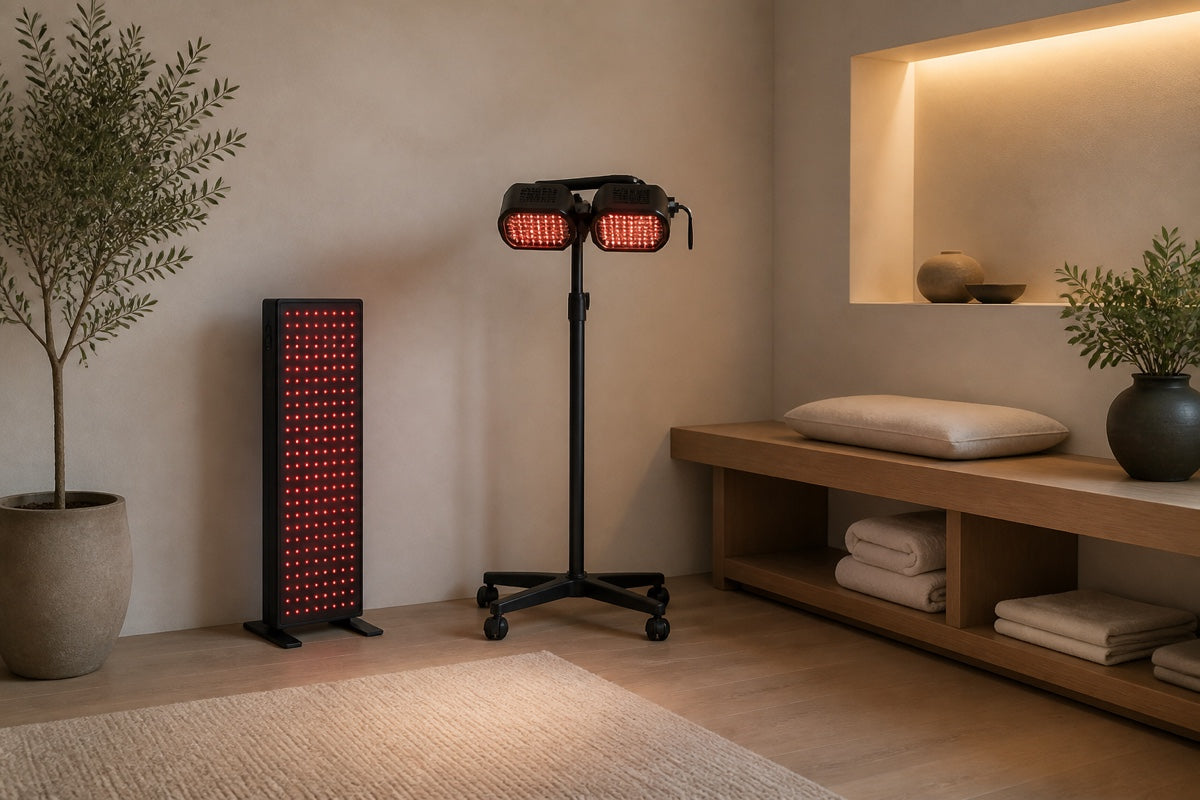



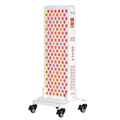
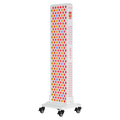
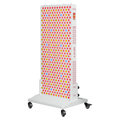
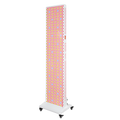



How Much Does a Red Light Therapy Panel Cost to Run? MARS 400 to 2000 Calculator
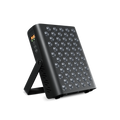
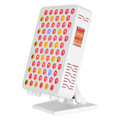
A red light therapy panel usually costs only a fraction of a euro per session to run. At an example tariff of €0.30 per kWh, a 10-minute session ranges from about €0.004 with the 82 W MARS 400 to €0.072 with the 1,440 W MARS 2000. Three sessions a week would equal roughly €0.64 to €11.23 per year.
Those are transparent reference estimates based on the nominal electrical power currently listed in the product specifications. They are not laboratory measurements of wall consumption. Use the calculator formula below with your own tariff; use a plug-in energy meter when you need the exact draw of your panel, mode and brightness setting.
Running cost in 30 seconds
- 10-minute MARS 400 session: about €0.004 at €0.30/kWh.
- 10-minute MARS 2000 session: about €0.072 at €0.30/kWh.
- Double the session time: the estimated electricity cost doubles.
- Nominal watts are a ceiling-style reference: dimming or selected channels may use less, but only a meter confirms it.
MARS 400 to 2000 electricity cost calculator
The table uses a 10-minute session, three sessions per week and an electricity price of €0.30 per kWh. Click a model to check its current product details, price and availability.
kWh per session = nominal watts × session minutes ÷ 60,000
Cost per session = kWh per session × your price per kWh
Estimated annual cost = cost per session × sessions per week × 52
Example cost at €0.30/kWh
| Panel | Nominal power | kWh per 10 min | Cost per session | 3× weekly / year |
|---|---|---|---|---|
| MARS 400 | 82 W | 0.014 kWh | €0.0041 | €0.64 |
| MARS 600 | 120 W | 0.020 kWh | €0.0060 | €0.94 |
| MARS 800 | 240 W | 0.040 kWh | €0.0120 | €1.87 |
| MARS 1000 | 360 W | 0.060 kWh | €0.0180 | €2.81 |
| MARS 1200 | 720 W | 0.120 kWh | €0.0360 | €5.62 |
| MARS 2000 | 1,440 W | 0.240 kWh | €0.0720 | €11.23 |
Rounded estimates. The MARS 2000 may be unavailable even though its reference calculation remains useful. Check live stock on the product page.
Use your own electricity price
- Find your tariff. Use the all-in variable energy price per kWh on your bill if you want a practical household estimate. Fixed standing charges do not change because of one panel session.
- Choose the real session time. Enter the minutes you actually use, not the longest timer setting.
- Choose the frequency. Multiply by sessions per week and 52 for a simple annual estimate.
- Recalculate when the setup changes. A longer session, different brightness or another panel changes the result.
Worked example: MARS 800
At 240 W, a 15-minute session equals 0.060 kWh. At €0.34/kWh that is €0.0204 per session. Four sessions a week equal about €4.24 per year: 240 × 15 ÷ 60,000 × €0.34 × 4 × 52.
Why nominal power is not the same as measured wall draw
The watt figure on a product page is a rated or nominal device value. It is useful for a conservative comparison because it gives every model the same calculation basis. It does not prove that the panel continuously draws that exact amount in every mode.
Selected wavelength channels, brightness, pulsing, power-supply efficiency and control electronics can change actual consumption. Standby power may also exist. For that reason, the table should be read as a reference estimate rather than an electricity-bill guarantee.
Do not replace a missing measured value with an unsupported lower number. If exact running cost matters, measure the complete panel and its own power supply at the wall for a normal session.
Electrical watts are not irradiance or light dose
Electrical power describes energy drawn by the device. Irradiance describes optical power reaching an area, usually in mW/cm² at a stated distance and mode. Fluence or dose adds time, usually in J/cm². These numbers answer different questions and cannot be exchanged.
A larger panel can draw more electricity because it illuminates a larger area. That does not mean its skin dose is simply the electrical wattage divided by body size, nor does a higher electricity bill guarantee a better outcome. Compare coverage, wavelengths, controls, distance guidance and the manual separately.
What else can affect the total cost?
The panel is usually the main electrical load. A powered stand, room cooling, heating or other equipment may add energy, but should not be silently assigned to the panel itself. Shipping, purchase price and replacement parts are ownership costs, not electricity costs.
Household tariffs can vary by country, contract and hour. If you have time-of-use pricing, calculate with the tariff that applies during the session. Solar generation can change your out-of-pocket cost, but the panel still consumes the same measured kWh.
Choose panel size by coverage, not pennies alone
The difference in electricity between the smallest and largest MARS models is real, but it is modest compared with the purchase decision. MARS 400 suits compact target areas and a straightforward 660/850 nm routine. MARS 600 adds nine selectable wavelengths and controls in a compact format.
MARS 800 and MARS 1000 increase vertical coverage. MARS 1200 and MARS 2000 are aimed at much larger treatment areas. Buying a panel that covers the intended area at the recommended distance can matter more than saving a few euros per year while extending or repeating sessions.
Check current price, availability, dimensions, modes and included accessories on each linked product. The cost table is for energy comparison; it is not a treatment recommendation or a promise of results.
How to measure the exact cost at home
A basic plug-in energy meter gives the clearest answer for your own setup:
- Connect the meter directly to the wall outlet, then connect the complete panel power supply to the meter.
- Reset the meter’s kWh reading and use the exact mode, brightness and session time you normally choose.
- Repeat two or three normal sessions so a tiny one-session reading does not dominate the rounding.
- Divide total kWh by the number of sessions, then multiply by your current price per kWh.
- Include standby only if you normally leave the panel plugged in; otherwise measure and report the active session separately.
Calculation and measurement sources
The US Department of Energy glossary defines a kilowatt-hour as one kilowatt acting for one hour.
A Department of Energy education guide uses the same appliance calculation: wattage multiplied by hours, divided by 1,000, gives kWh.
The Ealing Council household energy guide explains kWh and recommends a plug-in monitor to see what an appliance actually uses.
A peer-reviewed photobiomodulation parameters review separates wavelength, irradiance, fluence, treatment time and treatment schedule. That is why electrical watts are not presented here as skin dose.
Frequently asked questions
Are red light therapy panels expensive to run?
Usually not for short home sessions. With the example assumptions used here, the annual electricity estimate ranges from about €0.64 for MARS 400 to €11.23 for MARS 2000. Your tariff, time and frequency decide the real figure.
How much electricity does a 10-minute red light session use?
Using nominal power, the six MARS estimates range from 0.014 kWh to 0.240 kWh. Actual wall draw can differ by mode, brightness and power-supply efficiency.
Does a 20-minute session cost twice as much?
At the same power draw and tariff, yes. Energy use is linear with time: double the minutes and the calculated kWh and cost double.
Should I use rated watts or LED chip watts?
Use the current nominal electrical device value from the product specification, not a marketing total made by adding theoretical LED-chip maxima. For an exact answer, use a wall meter.
Does pulsing reduce electricity use?
It may change average draw, but the amount depends on the product implementation and settings. Do not guess a percentage; measure the chosen mode.
Which MARS panel is cheapest to run?
MARS 400 has the lowest nominal power and therefore the lowest reference electricity cost. Choose it only when its coverage, wavelengths and controls also fit your intended routine.
Compare all MARS panels
Use running cost as one practical input, then compare coverage, dimensions, wavelengths, controls, current price and stock before choosing.
View MARS 400