

Daylight Lamp 10,000 Lux: How Long, How Far and When?
A 10,000-lux daylight lamp is only 10,000 lux at the position where that brightness is specified. Distance, angle, brightness setting and time of day all change the routine. For the Resty Daylight Lamp, the practical reference point is up to approximately 10,000 lux at 80 cm in full-spectrum mode. This guide separates the product setup from clinical light-therapy protocols, so you can understand the number without turning a lifestyle lamp into a medical promise.
The practical answer
- Distance: use about 80 cm for the product’s approximate 10,000-lux reference point; around 100 cm is approximately 6,500 lux and 120 cm approximately 4,500 lux.
- Position: keep the panel in front of you so the focused beam reaches the eye area indirectly. You do not need to stare at the LEDs.
- Timing: use bright full-spectrum light in the morning or daytime. Keep it out of a deliberately dim late-evening routine.
- Duration: official clinical sources often describe roughly 20 to 45 minutes at 10,000 lux for seasonal affective disorder, usually early in the morning. That is a treatment protocol, not an automatic Resty dosage.
- Safety: check first if you have an eye condition, bipolar disorder, a photosensitive condition, light-triggered symptoms or medication that increases light sensitivity.
How far should a 10,000-lux daylight lamp be?
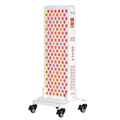
The current Resty Daylight Lamp 10,000 Lux uses a focused 30-degree lens. Its product page derives the following approximate values from the measured luminous flux and lens geometry:
| Distance from panel | Approximate illuminance | Practical setup | What changes |
|---|---|---|---|
| 80 cm | ≈ 10,000 lux | Recommended reference distance; panel centred in front | Highest listed daylight intensity |
| 100 cm | ≈ 6,500 lux | More room for a monitor, breakfast or paperwork | Lower illuminance because the beam spreads |
| 120 cm | ≈ 4,500 lux | A softer, wider desk setup | Not a 10,000-lux position |
These are product-derived estimates, not a promise that every point in a room receives the same lux. Measure at eye position with a suitable lux meter if the exact value matters. Moving the lamp to the side, selecting a lower brightness level or sitting outside the beam reduces exposure.
What does 10,000 lux actually mean?
Lux measures how much visible light reaches a surface. It is not the lamp’s total output and it is not a wavelength. A product can have a high lumen output yet deliver much less illuminance at your eyes if it sits far away, points elsewhere or spreads light across a wider area.
That is why a bare claim such as 10,000 lux is incomplete without a distance. Some compact lamps reach that value only very close to the face. Resty lists approximately 10,000 lux at 80 cm, which is unusually usable as a desk distance, but the centred 30-degree beam still matters.
Full spectrum also does not mean identical to outdoor sunlight. The laboratory report shows a continuous visible-light distribution at a correlated colour temperature of 5,430 K. It is an electric light source with measured colour properties, not the sun and not a source of every natural-light effect.
How long should you use a 10,000-lux lamp?
There are two different questions hiding inside how long. For a general morning or home-office routine, there is no single mandatory Resty session length in the current product instructions. Use the timer and five brightness levels to create a comfortable daytime block, and reduce brightness, increase distance or stop if the light feels unpleasant.

For treatment of winter-pattern seasonal affective disorder, official sources describe specific clinical routines. The US National Institute of Mental Health gives about 30 to 45 minutes daily at 10,000 lux, usually first thing in the morning. Mayo Clinic gives a typical reference of about 20 to 30 minutes within the first hour after waking. Those ranges depend on a suitable light box, the manufacturer’s distance, individual response and clinical context.
Do not convert the distance table into a home-made medical dose by simply doubling minutes at a lower lux value. Spectrum, geometry, timing, adherence, diagnosis and individual sensitivity also matter. If you are trying to treat persistent low mood, a sleep disorder or another symptom, discuss the device and timing with a qualified professional.
Important distinction: 10,000 lux is a brightness specification, not a diagnosis or treatment claim. The Resty Daylight Lamp is sold as a lifestyle product and is not presented in current product information as a medical device for mood or sleep disorders.
When is the best time to use it?
Morning after waking
This is the clearest default for a standard daytime schedule. Place the lamp at breakfast or beside the first work block so bright light is part of the start of your day. Clinical morning-light timing should still follow professional and manufacturer guidance.
During a dark home-office day
Use full-spectrum mode when the room feels dim and you want more visible daytime light. Keep the panel in front rather than far off to the side. Outdoor daylight remains useful when available; a desk lamp does not replace time outside.
Late afternoon or evening
Bright light can influence circadian timing, and expert consensus favours brighter days with dimmer evenings. If you are protecting an earlier bedtime, avoid making 10,000-lux full-spectrum mode part of the final hours before sleep. Shift workers and people with delayed or advanced sleep timing need personalised advice rather than a generic morning rule.
How to set up the Resty Daylight Lamp step by step
Use this as a product-positioning checklist:
- Choose full-spectrum mode. The 10,000-lux distance values apply to bright visible daylight, not automatically to the separate 660 nm or 850 nm modes.
- Start with the lamp in front of you. At 80 cm the focused beam is listed as approximately 43 cm wide, so a panel far to the side may miss the intended eye area.
- Set the distance. Use approximately 80 cm for the top listed intensity, or move to 100 to 120 cm for a lower, softer level. Do not assume a random desk position still gives 10,000 lux.
- Keep your eyes open without staring. Work, read or eat breakfast while the light remains in your field of view. Looking directly into the LEDs is unnecessary.
- Select a comfortable brightness. The product has five levels. More is not automatically better; choose the lowest setting and distance that fit the intended routine or professional plan.
- Use the timer. A timer makes the routine repeatable and reduces accidental long exposure. Do not treat it as proof that every available duration is appropriate for you.
- Check your response. Stop or adjust if you develop eye discomfort, headache, nausea, agitation or another light-triggered symptom.
Can you use a daylight lamp while working?
Yes, a desk or breakfast setup is the main practical advantage of this format. Put the panel behind or beside the front edge of your monitor so it remains roughly in front of you without blocking the screen. The listed beam width is about 43 cm at 80 cm, so a small position change can matter more than room brightness suggests.

Clear prescription glasses usually do not prevent ordinary use, but tinted, photochromic or blue-blocking lenses can change how much and which light reaches the eyes. Do not remove medically required eyewear. If exact circadian or clinical exposure matters, ask the professional who set the plan how your lenses affect it.
A daylight lamp is not general task lighting for the entire room. Keep normal room lighting on as needed for visual comfort and screen contrast. If the panel creates glare in the monitor, change its height or angle rather than staring through the reflection.
Resty specifications: measured values versus derived values
The March 2026 EVERFINE HAAS-1200 report and current product data support different parts of the claim. Keeping those categories separate makes the buying decision clearer.
| Specification | Current value | How to read it |
|---|---|---|
| Luminous flux | 1,428 lm | Directly listed in the laboratory report |
| Colour temperature | 5,430 K | Measured in full-spectrum mode |
| Colour rendering | CRI Ra 89.4 | Measured average colour-rendering index |
| TM-30 | Rf 93 / Rg 107 | Measured fidelity and gamut values |
| Electrical power in test | 49.78 W | Report value under the recorded test conditions |
| Lens and beam | 30°; ≈ 43 cm at 80 cm | Product geometry used for the distance estimate |
| Illuminance | Up to ≈ 10,000 lux at 80 cm | Derived product value; actual position and setting matter |
| Light modes | Full spectrum; 660 nm red; 850 nm NIR | Separate modes with different purposes |
You can inspect the full Resty HAAS-1200 test report (PDF). It directly lists spectrum, flux, colour and electrical measurements. The lux-by-distance table is described on the product page as derived from 1,428 lm and the 30-degree lens geometry; the report itself is not a separate three-distance lux measurement.
Daylight lamp, red-light mode or MARS panel?
Full-spectrum mode: bright visible daytime light
Choose full-spectrum mode on the Resty Daylight Lamp when a bright morning, desk or darker-room routine is the goal. This is the mode connected to the 10,000-lux positioning guidance.
660 nm and 850 nm modes: separate, softer routines
The lamp also has separate 660 nm red and 850 nm near-infrared modes. They are not 10,000-lux daylight modes, and their presence does not turn the compact lamp into a full-size body panel. Do not transfer the daylight duration table to these modes.
MARS 400: broader red and near-infrared body use
Choose the MARS 400 Red Light Panel when broader red and near-infrared coverage is the main buying priority rather than bright visible daytime light.
For more product separation, compare an LED face mask with a red light panel or read how an infrared heat lamp differs from a red light panel.
What independent guidance says
The US National Institute of Mental Health describes 10,000-lux light-box treatment for winter-pattern SAD as roughly 30 to 45 minutes, usually first thing in the morning, and flags eye disease and photosensitising medication as reasons for medical supervision.

The Mayo Clinic light-box guide gives a common reference of 20 to 30 minutes within the first hour after waking, with eyes open but without looking directly at the light. It also says to follow the manufacturer’s specified distance.
An international expert consensus on daytime, evening and nighttime light supports a broad pattern of brighter daytime exposure, much lower light before sleep and darkness during sleep. Its metric is melanopic equivalent daylight illuminance, which is not interchangeable with the photopic lux headline on a product page.
A systematic review of ocular safety found no evidence of eye damage in the reviewed light-therapy studies apart from one case report involving a photosensitising antidepressant, while noting that people with eye abnormalities or increased photosensitivity need more caution.
Who should check with a professional first?
Bright light is tolerated by many adults, but a product page cannot screen your eyes, medication or mental-health history. Get qualified advice before a clinical routine when any of these apply:
- an eye condition, prior eye injury, retinal disease, glaucoma, cataracts or diabetes-related eye changes;
- a photosensitive condition or medication or supplement that can increase sensitivity to light;
- bipolar disorder, a history of mania or a marked activation response to bright light;
- migraine, epilepsy or another condition with light-triggered symptoms;
- persistent low mood, major sleep disruption or another symptom you are trying to treat rather than a general daytime-light preference.
Stop and reduce exposure if the lamp causes eye pain, persistent visual disturbance, a strong headache, nausea, unusual agitation or a worsening symptom. Urgent or severe symptoms need appropriate medical assessment.
Choosing the Resty Daylight Lamp
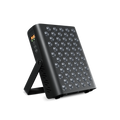
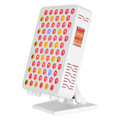
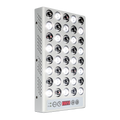
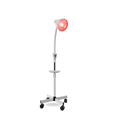
It combines a full-spectrum daylight mode, separate 660 nm and 850 nm modes, five brightness levels, a timer and a compact stand. The listed package includes the panel, stand, power cable and manual.
The strongest purchase signal is not simply 10,000 lux. It is the combination of approximately 10,000 lux at a usable 80 cm distance, a measured 5,430 K spectrum, desk placement and adjustable controls. A buyer who mainly wants body-scale red or near-infrared sessions should choose a MARS panel instead.
The current product information includes a 60-day trial and a three-year warranty. Verify the live price, stock and terms on the product page before ordering, because commercial details can change.
Frequently asked questions
How long should I sit in front of a 10,000-lux lamp?
Official clinical sources commonly describe about 20 to 45 minutes in the morning for SAD light-box treatment. That is not an automatic duration for every device or user. For Resty’s non-medical lifestyle use, follow the product instructions, use a comfortable setting and get professional guidance for treatment.
How far away should the Resty Daylight Lamp be?
About 80 cm is the listed reference for approximately 10,000 lux. At 100 cm the product estimate is about 6,500 lux and at 120 cm about 4,500 lux. Centre the focused beam rather than placing the lamp far off to the side.
Do I have to look directly at the lamp?
No. Keep your eyes open and the light in your field of view, but do not stare directly into the LEDs. You can eat breakfast, read or work during a comfortable routine.
Can I use it all day at my desk?
Do not assume longer is better. The high-intensity mode is different from ordinary room lighting. Use the timer, brightness controls and intended daytime routine; reduce exposure if it causes discomfort.
Can I use a daylight lamp in the evening?
If you want an earlier, dimmer wind-down, keep bright full-spectrum light out of the late evening. People with shift-work or circadian timing goals need individual guidance because the ideal light time can differ.
Is 10,000 lux the same at every brightness level?
No. The top figure belongs to the relevant full-brightness setup and distance. Lower settings, a longer distance or an off-centre position reduce illuminance.
Does full spectrum mean UV or sunlight?
No. Full spectrum here describes the measured visible-light distribution and colour characteristics. It does not mean the lamp is the sun or that every solar wavelength is present. The current product data does not support turning that phrase into a UV claim.
Can this lamp treat seasonal depression?
Persistent or seasonal depression deserves assessment. A clinician can determine whether light therapy is suitable and which certified device, timing and monitoring are appropriate.
Build a brighter morning or desk routine
See the current specifications, price and included accessories. Use full-spectrum mode earlier in the day, keep the distance honest and treat comfort and safety as part of the setup.
View the Resty Daylight LampEquipping several desks? Resty also supplies daylight lamps for workplaces.