Sleep Mask With Eyelash Extensions: Space, Pressure and Fit
Can you wear a sleep mask with eyelash extensions? Often, yes, but only when the mask leaves enough real clearance for your particular lash length and curl, stays stable without excessive strap tension and still fits when you turn your head. A contoured shape lowers the chance of direct fabric contact compared with a flat mask; it cannot guarantee zero contact, prevent pillow pressure or suit every set of extensions. Use the fit test below instead of trusting the words 3D, 4D or lash-friendly on their own.
Choose by real clearance
Three sleep-mask shapes, three different trade-offs
The best choice is the smallest, most comfortable design that passes your own lash-clearance test in the position in which you actually sleep.

Everyday contoured choice
Resty 4D contoured sleep mask
A soft, adjustable light-blocking mask with shaped eye zones and room around the eyes and eyelashes. Best when its actual fit clears your extensions.
Maximum-clearance category
Dedicated lash shield or deeper cups
Potentially the better category for very long or high-curl extensions when verified internal depth matters more than compactness.
Thin and packable
Flat fabric sleep mask
Compact and simple, but more likely to rest directly on eyelids or lashes. Choose it only when lash contact is not a concern.
Short answer: start with a contoured adjustable mask for normal daily use and travel, but keep it only if every extension stays clear while blinking and turning. For unusually long, dramatic or freshly applied sets, a purpose-built shield with published cup dimensions may be the more cautious purchase. A flat mask is the weakest fit for contact-sensitive lashes.
Sleep masks for eyelash extensions at a glance
| Decision factor | Resty 4D contour | Deep-cup lash shield | Flat fabric mask |
|---|---|---|---|
| Inner eye space | Contoured space around eyes and lashes; no depth in mm stated | Often deeper, but verify the actual dimensions | Little or no dedicated cavity |
| Chance of lash contact | Lower than a flat mask when the fit is correct | Potentially lowest when cups match the wearer | Usually highest |
| Blinking test | Should allow blinking without brushing the lining | Should allow free blinking inside the cup | Often touches lids or lashes |
| Strap control | Soft adjustable band | Usually adjustable; hardware varies | Elastic or adjustable depending on model |
| Light blocking | Designed for a light-blocking fit | Depends on nose seal and cup placement | Can block well, but may need tighter tension |
| Side sleeping | Designed for side and back sleepers; pillow can still shift it | Large or rigid cups may press at the side | Thin edge, but direct lash pressure remains |
| Cleaning | Follow the product care instructions and dry fully | Cup construction may need extra drying | Often simple, but material instructions vary |
| Portability | Compact for home, travel and naps | Can be bulkier | Usually the flattest option |
| Strongest buying signal | Balanced eye space, adjustability and compactness | Published, sufficient cup depth for your lash set | Low price and thin storage |
| Main trade-off | Clearance is personal and not specified in millimetres | Bulk, rigid edges or a larger profile | Direct contact and pressure are more likely |
Can you wear a sleep mask with eyelash extensions?
Yes, provided the inner surface does not touch, catch or bend the extensions in normal use. The word contoured is useful only as a starting point. Extension length, curl, fan volume, eye prominence, cheek and brow shape, nose bridge, strap position and sleeping posture all change the available space.
Do not judge the fit while sitting upright for ten seconds. A mask can clear the lashes when loose, then move backwards when tightened for darkness or when the pillow pushes on its outer edge. The practical question is not whether a product category is compatible; it is whether this exact mask remains clear on this exact face through blinking, head movement and the normal sleep position.
A correctly fitted contoured mask may reduce direct contact compared with a flat panel of fabric. It cannot isolate the extensions from every source of friction. Your hand, pillow, duvet and the mask edge can still touch them, especially when sleeping on the side or front.
The four-step lash-clearance test
Run this test in good light before wearing a mask for a full night. If the extensions are new, first follow the timing and care instructions from the technician who knows the adhesive and application.

1. Set the lightest stable strap tension
Place the lower and upper edges on the bony area around the eyes, not across the lash line. Start loose and tighten only until the mask stays in place. Extra tension can pull the eye cups backwards, reducing the very clearance the contour was meant to create.
2. Blink and look in every direction
With clean, dry lashes, blink normally and look up, down and sideways. Stop if you feel brushing, snagging or resistance. Clearance should apply to the longest outer and centre lashes, not only the shorter inner corner.
3. Check the seal without sacrificing space
Face a bright room with eyes closed. Adjust the nose bridge and strap gently. If blocking the last light leak requires enough tension to touch or bend the extensions, the mask is not the right shape for this set, even if its product page calls it lash-friendly.
4. Recreate your real sleep position
Lie down for 20 to 30 minutes, turn to each side you use and place your head on the normal pillow. Recheck for movement, cup collapse, edge pressure and lash contact. A side pillow can rotate the mask or push an outer cup inward; an upright fit test will miss that.
Fresh eyelash extensions: the technician's aftercare leads
There is no responsible universal waiting period that applies to every adhesive, curing method, environment and technician protocol. Some online advice gives one fixed number of hours, but the person who performed the application should provide the relevant aftercare. Follow that instruction before adding a mask, steam, cleanser, makeup or any other item around the eyes.
If you want to use a sleep mask on the first night, ask specifically whether the adhesive and set are ready for it and whether a mask edge could interfere with the application. When in doubt, leave the eye area uncovered for that night rather than tightening a mask to make it work.
A mask is not an aftercare treatment and it does not guarantee better retention. Its realistic role is to block light while, if the shape fits, reducing direct fabric contact compared with a flat mask.
Side sleeping changes the fit
A contoured cavity protects space from the front; side sleeping adds force from another direction. The pillow can push the temple edge towards the eye, rotate the mask, pull the strap or compress a deep cup. This is why a design advertised for side sleepers still needs an on-pillow test.
Pay attention to edge thickness and strap hardware near the temple. A very deep cup may offer generous frontal clearance but feel bulky against a pillow. A softer, lower 4D contour may be easier at the side but offer less room for unusually long extensions. Neither architecture wins for every face.
No sleep mask prevents the uncovered lashes themselves from meeting the pillow if the mask shifts or your face turns downwards. If pillow contact is your main problem, review sleep position and ask the lash professional for set-specific aftercare rather than expecting a mask to act as a rigid guard.
Contoured mask, dedicated shield or flat mask?
Choose a contoured 3D or 4D mask for balanced daily use
This category balances eye space, light blocking, soft construction and packability. It is the logical first option for most wearers, provided the personal clearance test passes. Ignore the number in 3D or 4D as a measurement; it describes a shape, not a standardised cup depth.

Choose a dedicated lash shield when clearance is the priority
A deeper or more rigid cup can be a better fit for very long, dramatic or high-curl sets. Look for actual internal measurements, adjustable placement and a return policy. Deep does not automatically mean comfortable: the rim, nose bridge and side profile still have to match the face.
Choose a flat mask only when contact is acceptable
A flat mask is easy to store and may block light well, but the fabric typically rests on the eyelids and lashes. Silk or satin can feel smoother than a rough textile, yet a smooth material does not create physical clearance. Material and architecture solve different problems.
How the Resty 4D mask fits this decision
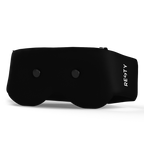
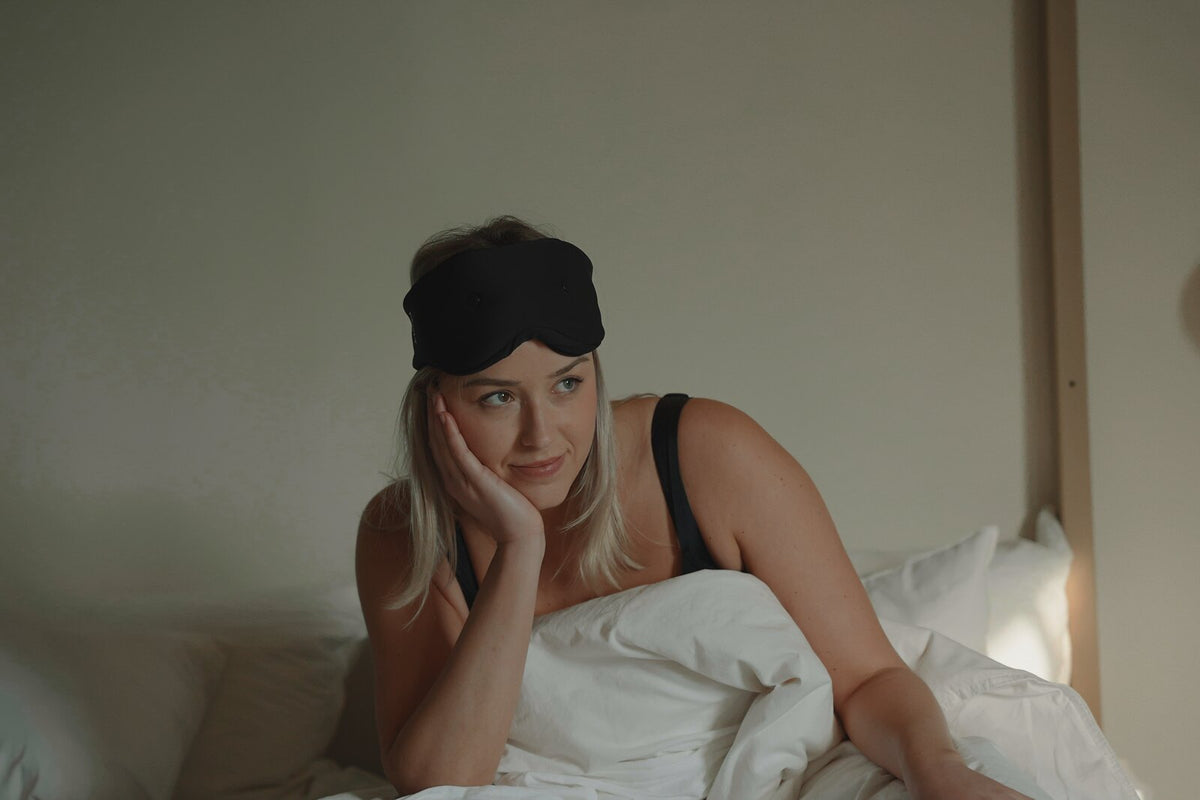
The Resty 4D Sleep Mask has contoured eye zones with space around the eyes and eyelashes, a soft adjustable band and a light-blocking fit. It does not lie flat across the eyes and is designed for side and back sleepers. Its compact format suits home, travel and naps.
The honest limit is equally important: Resty does not state a universal cup depth in millimetres, and the product is not sold as a dedicated rigid shield for every eyelash-extension style. We therefore cannot promise clearance for a particular length, curl or face shape. Buy it for its contoured, adjustable design and keep it only if the four-step test confirms space.
Set the band firmly enough for stability, not as tight as possible. You should be able to blink without feeling the inner lining. If you need to overtighten it to stop nose-area light, fit, not force, is the issue.
Cleaning and eye-area hygiene
Anything worn around the eyes collects skin oil, skincare and environmental residue. Follow the mask's care instructions, use clean hands, rinse cleaning product completely when relevant and allow every layer to dry before reuse. Store it in a clean, dry place and do not share it.
Keep the eye area and extensions clean according to the lash professional's instructions. Do not use a sleep mask to cover redness, swelling, discharge or an irritated lash line. A dirty mask, rough edge or damaged lining is a reason to clean, repair or replace it, not to tighten the strap.
Remove the mask slowly with the eyes closed. Lift it away from the face rather than dragging its lower edge over the lashes. If a lash seems caught, stop and release the fabric gently instead of pulling.
What the evidence supports, and what it does not
The U.S. Food and Drug Administration's eye-cosmetic safety guidance classifies false eyelashes, extensions and their adhesives as cosmetics and stresses that eyelids are delicate. It supports careful hygiene, ingredient awareness and stopping after irritation; it does not certify any sleep-mask shape as safe for all extensions.

A published clinical case review of ocular disorders associated with eyelash extensions reported conditions including keratoconjunctivitis and allergic blepharitis after extension procedures. It is relevant to symptom boundaries and adhesive risk, not evidence that a contoured mask causes or prevents those conditions.
A peer-reviewed review of eyelid cosmetic enhancements discusses mechanical and chemical complications around eyelash extensions. That supports being cautious with pressure, friction and hygiene near the eye; it does not provide a tested minimum eye-cup depth.
A current WIRED sleep-mask buying guide treats adjustable fit and eye cups as practical buying criteria and notes their usefulness for eyelash extensions. This is editorial product guidance, not medical evidence or a guarantee for Resty's fit.
Independent editors at Travel + Leisure tested contoured sleep masks and found that eye-space, light leakage and comfort vary by model and wearer. The useful takeaway is to test the whole fit rather than assume every contoured mask performs the same way.
When not to wear the mask
Do not put a mask over a painful, swollen, inflamed or injured eye area. Remove it if you notice burning, stinging, pressure pain, blurred vision after removal, new sensitivity to light or worsening irritation. The mask is a sleep accessory and does not treat an adhesive reaction, infection or eye condition.
For persistent redness, swelling, discharge, significant pain, light sensitivity or visual changes, seek prompt advice from an appropriate eye-care or medical professional. Contact the lash professional for application-specific questions, but do not let cosmetic aftercare delay medical evaluation of eye symptoms.
- Do not force the fit: lash contact, snagging or painful pressure means stop and readjust or choose another shape.
- Avoid weighted pressure: a weighted eye mask can negate the benefit of a cavity unless its design and fit clearly keep weight away from the eyes and lashes.
- Do not promise retention: application quality, natural lash cycle, adhesive, cleansing, rubbing, moisture and sleep position all affect how a set wears.
- Follow individual aftercare: the technician's current instructions for the exact adhesive and set take priority over a generic online timetable.
Exact Resty product specifications
This guide uses the current product record rather than adding unverified dimensions or cosmetic promises:
- Shape: contoured 4D fit with space around eyes and eyelashes.
- Light: designed for a light-blocking fit.
- Pressure: soft and adjustable; it does not lie flat on the eyes.
- Position: designed for side and back sleepers.
- Routine: compact for home, travel and naps.
- Fit instruction: secure without uncomfortable pressure; the contour should leave room to blink.
- Boundary: no stated internal depth in millimetres, no universal lash-clearance guarantee and no promised medical or sleep outcome.
Frequently asked questions
Can you wear a sleep mask with eyelash extensions?
Yes, if the inner surface and edges remain clear of the extensions while you blink, lie down and turn your head. A contoured label alone is not enough; run the fit test.
What is the best sleep mask for eyelash extensions?
Usually a contoured adjustable mask that gives enough verified space for your lash length without excessive strap tension. Very long or dramatic sets may need a deeper purpose-built shield.
Will a 3D or 4D mask damage eyelash extensions?
Not automatically, but it can if the cups are too shallow, the band is too tight, the mask shifts or an edge catches the lashes. 3D and 4D are not standard depth measurements.
How long after eyelash extensions can I wear a sleep mask?
Ask the technician who performed the service and follow the adhesive-specific aftercare. There is no single waiting period that is correct for every application system.
Is silk better than a contoured sleep mask?
They describe different features. Silk or satin concerns surface feel; contour creates physical space. A flat silk mask can still touch the lashes, while a contoured mask can still fit poorly.
Can side sleepers use a mask with extensions?
Yes, but test on your actual pillow. Side pressure can rotate the mask or push a cup inward even when the front clearance looks adequate while sitting.
Does the Resty 4D mask guarantee no lash contact?
No. It has contoured eye zones and room around eyes and lashes, but Resty does not publish one universal cup-depth guarantee. Face shape, lash style, tension and sleep position determine the final clearance.
Test the fit, not the label
Want a soft contoured mask with space around the eyes?
The Resty 4D Sleep Mask combines shaped eye zones, an adjustable band and a compact light-blocking design. Check your own lash clearance before a full night.
View the Resty 4D Sleep Mask