


660 nm vs 850 nm Red Light: Which Should You Choose?
The practical difference between 660 nm and 850 nm is not that one is universally stronger. A 660 nm LED emits visible deep-red light. An 850 nm LED emits near-infrared light that is mostly outside normal human vision. Their optical behaviour in tissue differs, but wavelength is only one part of a real setup: irradiance, distance, exposure time, beam distribution, area and the device manual matter too. This guide explains the distinction without turning a specification into a guaranteed health result.
The short buying answer
- Choose 660 nm when you specifically want a visible red-light mode and a protocol or device that names 660 nm.
- Choose 850 nm when you specifically want near-infrared output and accept that active LEDs may look dark because 850 nm is largely invisible.
- Choose both when a device supports a combined red-and-NIR routine and its own instructions call for that mode.
- Do not choose by wavelength alone. Check irradiance at a stated distance, time, coverage, controls and eye-safety instructions.
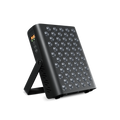
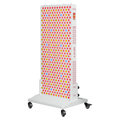
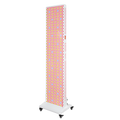
- For Resty: MARS 400 is the simple 660/850 nm model; MARS 600 through 2000 add seven other selectable wavelengths and more controls or coverage.
660 nm vs 850 nm: the main differences
| Feature | 660 nm | 850 nm |
|---|---|---|
| Band | Visible red light | Near-infrared, usually classed as IR-A |
| What you see | A clear red glow | Little or no visible glow; a faint red point can occur |
| Tissue optics | Generally more superficial delivery than 850 nm in the same tissue and geometry | Often relatively deeper delivery, but no universal depth |
| Heat | Not a heat-lamp specification | Still not automatically a heating mode or infrared sauna |
| Best buying signal | The protocol specifically asks for 660 nm | The protocol specifically asks for 850 nm; or use combined mode when supported |
Why can you see 660 nm but not 850 nm?
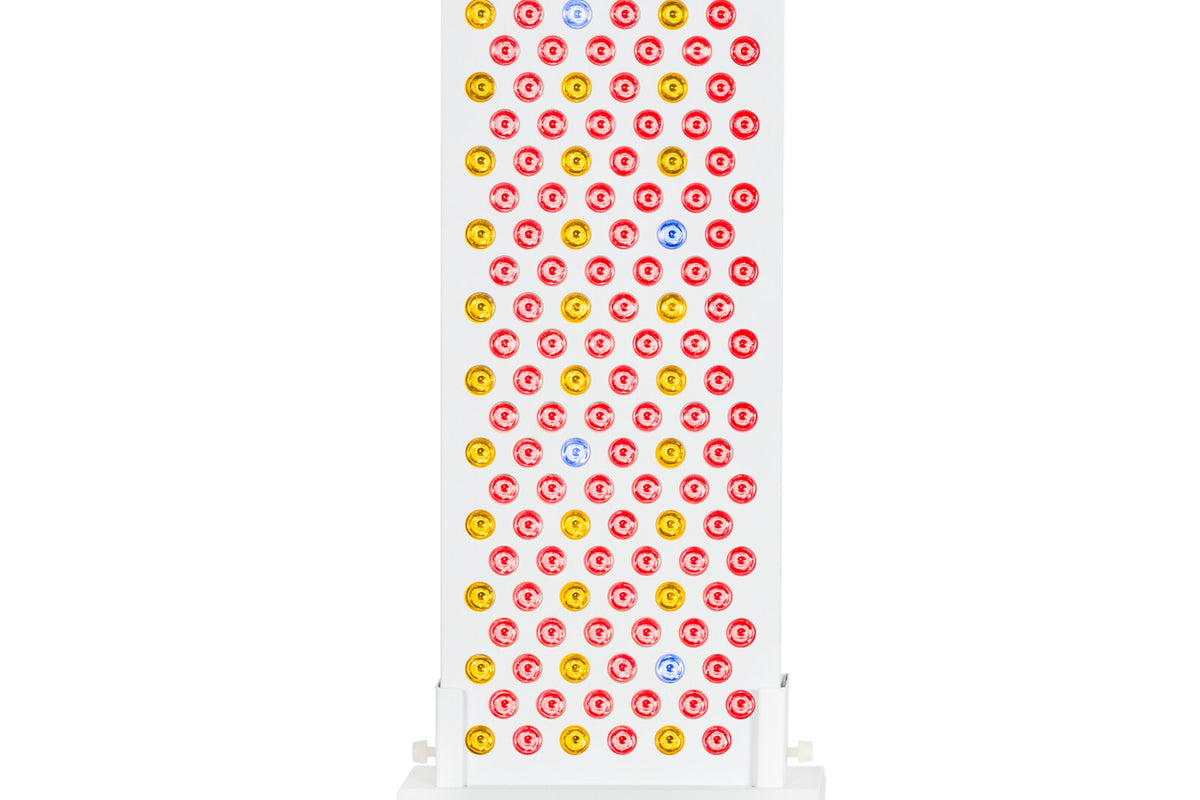
Nanometres describe wavelength. At 660 nm, the output sits in the red part of the visible spectrum, so operating LEDs look red. At 850 nm, the wavelength sits in near-infrared. Your eyes normally do not show you the real optical output, which is why an NIR bank can be active even when it appears off.
Do not use brightness to compare the two modes. Visible red can look much brighter while an optical meter records substantial 850 nm output. Conversely, a faint visible red glow from an 850 nm diode is not a calibrated measure of its NIR power. The display, selected mode and manual are the useful checks.
Does 850 nm penetrate deeper than 660 nm?
Under comparable conditions, longer near-infrared wavelengths often encounter a different balance of absorption and scattering than visible red, so 850 nm can deliver a larger relative fraction of incident light beneath superficial layers. That is the careful reason people describe 850 nm as the deeper option.

A fixed statement such as “660 nm reaches the skin and 850 nm reaches exactly X centimetres” is not reliable for a home panel. Delivered light falls continuously with depth and changes with skin, blood, water, tissue type, angle, contact or non-contact use, source size and irradiance. Laboratory models, animal tissue and a panel used across a room are not interchangeable.
Deeper is not automatically better. A target near the surface does not become less relevant because a longer wavelength exists, and a nominally deeper wavelength is not evidence that enough energy reached a specific muscle or joint. Match the complete device and protocol to the intended routine rather than ranking two numbers in isolation.
Can you use 660 nm and 850 nm together?
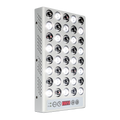
Yes, when the product provides a combined mode. MARS 400 has separate Red, NIR and Combined settings. In Combined mode, its 30 red and 30 NIR LEDs operate as the device was designed to use them. MARS 600 and the larger nine-wavelength models let you select and dim individual wavelength channels.
Combined does not mean double the useful dose. A combined irradiance figure may describe total measured optical power from all active channels, not the individual 660 nm and 850 nm contribution. Switching from one channel to every channel can therefore change both spectral mix and total irradiance.
Do not stack a red-only session and an NIR-only session merely to make the routine stronger. Follow the selected panel’s manual, keep distance and time repeatable and change one variable at a time if you are testing comfort or practical fit.
Why wavelength is not the same as dose
Irradiance is the incident optical power per area, commonly listed as mW/cm². Exposure time turns that into incident radiant exposure: as a simple headline calculation, mW/cm² multiplied by seconds and divided by 1,000 gives J/cm². That arithmetic still does not tell you how uniformly the panel covers the area or how much light reaches a particular tissue depth.
Electrical wattage is different again. The 82 W on MARS 400 and 120 W on MARS 600 are nominal electrical device figures, not the dose arriving at your skin. Use a product’s irradiance only when the distance and mode are stated, and avoid comparing measurements from different brands as if their meters and methods were identical.
Photobiomodulation research also reports biphasic responses: more exposure does not automatically produce a larger useful response. This is why copying a clinical protocol from another wavelength, irradiance, source geometry or medical device into a Resty session is not evidence-based.
Which Resty panels include 660 nm and 850 nm?
Product records were checked on 24 July 2026. All six active MARS panel listings include both 660 nm and 850 nm. MARS 400 is a dedicated two-wavelength model; MARS 600, 800, 1000, 1200 and 2000 list nine selectable wavelengths. Prices and availability below are the recorded state at that check.

| Panel | Selectable wavelengths | LEDs / nominal power | Published output | Housing | Price at check |
|---|---|---|---|---|---|
| MARS 400 | 660 + 850 nm | 60 / 82 W | ≥130 mW/cm² at 15 cm | 36 × 30 × 10 cm | €189 |
| MARS 600 | 480, 590, 630, 660, 670, 810, 830, 850, 1060 nm | 72 / 120 W | ≈157.6 mW/cm² at 15 cm, combined R+NIR | 32 × 23 × 6.5 cm | €379 |
| MARS 800 | 480, 590, 630, 660, 670, 810, 830, 850, 1060 nm | 144 / 240 W | Follow the current product manual | 64 × 23 × 6.5 cm | €669 |
| MARS 1000 | 480, 590, 630, 660, 670, 810, 830, 850, 1060 nm | 216 / 360 W | Follow the current product manual | 92 × 23 × 6.5 cm | €849 |
| MARS 1200 | 480, 590, 630, 660, 670, 810, 830, 850, 1060 nm | 432 / 720 W | Follow the current product manual | 92 × 42 × 7 cm | €1,495 |
| MARS 2000 | 480, 590, 630, 660, 670, 810, 830, 850, 1060 nm | 864 / 1,440 W | Follow the current product manual | 184 × 42 × 6.5 cm | €2,795; currently unavailable |
MARS 2000 was active but unavailable for sale at the time of the check, so it is shown for range completeness rather than as an immediate purchase recommendation. The MARS 800 to 2000 product descriptions do not publish a comparable 15 cm irradiance figure; this table does not invent one.
Which Resty panel should you buy?
Buy MARS 400 for a simple 660/850 nm routine
Choose MARS 400 when you want an available €189 tabletop panel, smaller target areas, three straightforward modes and an automatic 10-minute timer. Its specification names at least 130 mW/cm² at 15 cm. It is the clearest match for the exact search question without paying for seven extra wavelengths.
Buy MARS 600 for compact size and channel control
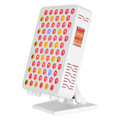
Choose MARS 600 when a compact panel still suits your space but you want nine selectable wavelengths, per-channel brightness, pulsing, touchscreen, remote and app control. Its product specification gives approximately 157.6 mW/cm² at 15 cm in combined R+NIR mode. More controls add flexibility, not a guaranteed better result.
Buy MARS 800 or 1000 for more vertical coverage
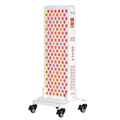
MARS 800 is 64 cm tall and MARS 1000 is 92 cm tall. Both carry the same nine-wavelength list. Choose between them mainly by the body area you want to cover, available mounting space and budget, not because 660 or 850 nm changes between the two.
Buy MARS 1200 for width; check MARS 2000 availability
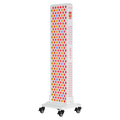
MARS 1200 keeps the 92 cm height but widens the housing to 42 cm. MARS 2000 extends that format to 184 cm for full-body placement, but it was listed as unavailable at this check. Do not plan a current purchase around an out-of-stock model without checking the live page.
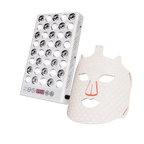
Also compare an LED face mask with a red light panel, learn why an infrared heat lamp is not the same product and read the Resty eye-safety guide.
How to choose and use a wavelength mode
Use this as a buying and setup checklist, not as a treatment prescription:

- Name the intended routine. Face, one joint-sized area, half body and full body require different coverage even when the wavelengths match.
- Read the real mode list. Confirm whether 660 and 850 nm can run separately, together or only inside a preset.
- Check the measurement distance. An irradiance value without distance cannot define your position.
- Keep distance and time consistent. Moving closer changes irradiance and beam coverage; do not compensate by guessing.
- Do not judge NIR by eye. Use the panel indicators because 850 nm is largely invisible.
- Follow eye-protection instructions. Included glasses are not decorative; use them whenever the manual calls for them and never stare into high-output LEDs.
- Stop at a concerning reaction. Pain, persistent eye or skin symptoms, an unexpected burn, severe headache or symptom worsening requires stopping and appropriate advice.
What the independent evidence does, and does not, show
The International Commission on Illumination definition of infrared radiation places IR-A from 780 to 1,400 nm while noting that the exact visual boundary is not absolute. This supports calling 850 nm near-infrared and 660 nm visible red; it does not rank therapeutic effects.
A peer-reviewed review of PBM light parameters and efficacy describes why wavelength, irradiance, fluence, source type, tissue and protocol interact. It is a warning against turning 850 nm into a universal depth claim or 660 nm into a universal skin-only claim.
The review of biphasic dose response in low-level light research explains why a response can rise and then fall as exposure changes. It supports the rule that longer or stronger is not automatically better.
A 2025 randomised, double-blind, sham-controlled facial-mask study tested 630 nm red plus 850 nm NIR with a defined device and 16-week protocol. It did not compare 660 against 850 as isolated winners and did not test a Resty panel.
A 2020 prospective controlled home-use study used a 660/850 nm LED mask together with a hyaluronic-acid ampoule. Because the combination and device were specific, the result cannot prove that any 660/850 panel, mode or session produces the same outcome.
The US FDA overview of non-thermal photobiomodulation procedures distinguishes low-level light from heat-based procedures and flags eye protection, photosensitivity and medication considerations. Resty MARS panels remain general-wellness products, not FDA-cleared evidence for the conditions discussed on that page.
Safety before choosing red or NIR
An invisible wavelength is not an invitation to ignore exposure. Follow the exact manual and get qualified advice before use when relevant.
- Do not stare into the LEDs. Use the included protective glasses whenever the selected manual recommends them.
- Ask first with an eye disorder, recent eye procedure, unusual light sensitivity or a history of light-triggered symptoms.
- Check medicines and topical products when they can increase photosensitivity; a pharmacist or clinician can assess the actual product.
- Do not use a wellness panel to self-treat a diagnosed condition, unexplained pain, a suspicious skin lesion or a persistent symptom.
- Keep the panel stable, ventilated and dry; use the supplied power equipment and do not cover active LEDs.
Resty MARS panels are sold for general wellness, skin-care and fitness routines. They are not medical devices and do not diagnose, prevent, treat or cure a disease. Personal results cannot be guaranteed from a wavelength label.
Frequently asked questions
Is 660 nm better than 850 nm?
Not universally. They are different bands with different visibility and tissue optics. The better choice is the wavelength and complete device setup that matches a justified protocol, target area and manual.
Is 850 nm stronger than 660 nm?
A longer wavelength is not the same as stronger output. Strength at your position depends on optical power, irradiance, distance, beam and active mode. 850 nm can appear dark while still delivering output.
Does 850 nm always go deeper?
It often has relatively deeper delivery under comparable tissue and geometry, but there is no fixed consumer-panel depth. Light attenuates continuously and varies by tissue, skin, angle and device parameters.
Can I use 660 and 850 nm at the same time?
Yes when the panel provides a combined mode and the manual supports it. MARS 400 offers Red, NIR and Combined. Do not assume combined means twice the useful dose.
Why do the 850 nm LEDs look switched off?
Most 850 nm output is outside normal vision. Use the selected mode and device indicators, not visible brightness, to check operation. A faint glow is not an output measurement.
Are 660 nm and 850 nm UV?
No. 660 nm is visible red and 850 nm is near-infrared. Neither is ultraviolet. Near-infrared is also not automatically a heat-lamp or sauna wavelength in the way a consumer may use those product names.
What is the best 660/850 nm Resty panel?
MARS 400 is the simplest and lowest-priced exact dual-wavelength option. MARS 600 adds nine channels and controls. Larger models mainly add coverage. Best therefore depends on area, controls, space and budget.
How long should a 660 or 850 nm session last?
Use the selected panel’s manual. Wavelength alone cannot set time because irradiance, distance, mode and area differ. MARS 400 has an automatic 10-minute timer, but that does not make ten minutes a universal protocol for every device or person.
Start with the panel, not just the number
Choose MARS 400 when a simple 660 nm red, 850 nm NIR or combined tabletop routine fits your goal. Compare larger MARS models when coverage or per-channel control matters more. Verify the current price, stock and manual before ordering.
View MARS 400