
Article: Does Red Light Therapy Work Through Clothes? What the Research Shows

Does Red Light Therapy Work Through Clothes? What the Research Shows
Short answer: partly. Near-infrared light (around 850 nm) passes through thin clothing in part, while visible red light (around 660 nm) passes far less. In laboratory measurements, thin cotton let through roughly a quarter to just over a third of near-infrared light. A dark colour, a dense fabric and every extra layer take away more. If you want the light from your red light panel to reach your skin, uncover that area. The rest of your body can stay dressed.
Almost everyone who starts red light therapy runs into this question. Do you need to take your shirt off? Can you keep your gym shorts on? And does red light therapy work through clothes at all if you simply sit in front of the panel in your jumper? Below you will find what research shows, why red and near-infrared light behave differently and what you can keep on during a session.
Key points
- 850 nm (near-infrared) partly passes through thin fabric. Researchers even saw it through six layers of clothing, though with clearly lower intensity.
- 660 nm (red) is blocked more strongly, especially by dark and dyed fabric.
- Every layer counts. Two layers that each pass 30% pass roughly 9% together.
- A red glow through your shirt says little about how much light reaches your skin.
- Do not compensate with longer sessions or a shorter distance. Uncover the skin instead.
What happens when light hits fabric?
Fabric is not a window. Light that hits a textile is partly reflected, partly absorbed by fibres and dyes and partly scattered between the threads. What is left reaches your skin. How much that is depends on four things:
- Wavelength. Most fabrics block near-infrared less than visible light.
- Colour. Dyes work by absorbing visible light. A black shirt looks black because it absorbs almost all visible light, including the red part.
- Thickness and density. A densely woven or thick fabric passes less than a thin, open one.
- Number of layers. Each layer takes away another share.
Does red light go through clothes? What the research shows
No large study has measured every type of clothing at exactly 660 and 850 nm. There are, however, three useful studies, and they point the same way.
| Study | What was measured | Result |
|---|---|---|
| Jeffery et al., Scientific Reports, 2025 (University College London) | 850 nm light from a red light therapy lamp behind a T-shirt, a shirt and a wool jumper (six layers of fabric), photographed with an infrared camera | Clothing reduced the intensity but was not a barrier. At 850 nm the clothing was nearly 100 times more transparent than for visible light. Measured with images, no percentage given. |
| Dobnik Dubrovski et al., Polymers, 2023 (University of Maribor) | Thin woven cotton fabrics of 0.35 to 0.45 mm, undyed and dyed with natural dyes, measured from 210 to 1200 nm | At 950 nm, 26 to 37% passed through. At 770 nm, just beyond visible red, 10 to 35%. The darkest fabric passed the least, and so did a denser weave. |
| Fuada and Katz, Results in Engineering, 2025 (University of Oulu) | 850 nm light through a layer of black cotton and animal tissue, for wireless data and energy transfer | The cotton layer clearly reduced the amount of light, but some light still passed through. |
These were woven fabrics or test set-ups in a laboratory. A T-shirt is usually knitted and often made of blended or synthetic fibres. Treat the percentages as an order of magnitude, not as a fixed value for your shirt. The direction is the same in all three studies: light gets through, but a large share is held back.
A worked example for layers. If one layer passes about 30%, two layers pass roughly 30% of 30%: around 9%. With a shirt and a jumper on top, little is left. In reality light also bounces between layers, so the exact figure differs, but the principle holds.
Why does 850 nm pass through clothing better than 660 nm?
Visible red light is strongly absorbed by dyes. In the near-infrared, most dyes and fibres absorb far less. As a result, the colour of your clothing matters much less at 850 nm than at 660 nm.
The Maribor measurements show this. At 770 nm, cotton dyed with beetroot passed 34.7% and the same cotton dyed with walnut, a dark brown colour, passed 22.8%: a 12-point difference. At 950 nm the figures were 36.8 and 35.7%, a difference of just over 1 point.
What does that mean in practice? If you wear a dark shirt, little of your panel's red light gets through, while a fair share of the near-infrared does. But a fair share is still much less than on bare skin. If your panel also has other visible wavelengths, such as blue or amber, the same applies to those colours as to red: visible light passes through fabric less well than near-infrared. For more on the two wavelengths, read 660 nm vs 850 nm: which red light therapy wavelength should you choose?
Which clothing lets the most light through?
The table below is an estimate based on the measurements above. Exact values for your clothing and your panel can only be measured.
| Situation | Red (660 nm) | Near-infrared (850 nm) |
|---|---|---|
| Bare skin | All | All |
| Thin, light or undyed cotton, one layer | Some | Roughly a quarter to a third |
| Thin dark shirt, one layer | Little | About the same as a light shirt |
| Thick or densely woven fabric, such as denim or a sweatshirt | Little | Less than thin fabric |
| Several layers, such as a shirt with a jumper | Very little | A small share |
Does a white shirt let more through? Not necessarily. White mainly means the fabric absorbs little visible light, but a white shirt also reflects a lot of light. White is not the same as transparent. For red light, a thin light shirt is better than a dark one; for near-infrared the difference is small.
What about a red glow through your shirt? If you can see the panel glowing red through your clothing, you only know that some visible light gets through. You cannot see near-infrared, and you cannot judge by eye how much light reaches your skin.
Why can you feel warmth through your clothes?
Under an infrared heat lamp you often feel the warmth straight through your shirt. That seems to prove the light passes through, but feeling warmth is a poor measure. Besides near-infrared, a heat lamp emits a lot of longer-wave infrared, and textiles block most of that. For long-wave infrared, researchers assume ordinary clothing passes only a few per cent. The fabric absorbs that energy, warms up and passes the heat on to your skin. What you mostly feel is warm fabric.
The reverse is also true: feeling little through your shirt under an LED panel does not mean nothing gets through. The difference between the two devices is explained in infrared heat lamp vs red light therapy panel.
Should you use it longer or sit closer?
No. Do not use clothing as a reason to change the time, brightness or distance beyond your device's manual. There are three reasons:
- You do not know how much your clothing blocks. A rule such as 'twice as long through a shirt' is guesswork.
- Fabric warms up. What does not pass through partly turns into heat in the fabric. Sitting closer to the panel with clothes on can get hot and uncomfortable.
- Folds and seams make it uneven. One spot gets more light than another, and that changes as soon as you move.
Keep to the distance and time for your panel and uncover the area. How to choose them is covered in our guide red light therapy with MARS: how long, how close and which mode.
What to wear for red light therapy
You do not need to undress completely. Only the skin you want to reach needs to be uncovered. Underwear, gym shorts or swimwear are fine, as long as they do not cover that area.
| Body area | Practical choice | Watch out for |
|---|---|---|
| Face and neck | Your clothes can stay on | Hair away from your face, no scarf or roll neck. Wear the supplied protective glasses. |
| Chest and stomach | Shirt off; a sports bra or bikini top is fine | Straps outside the area you want to reach |
| Back and shoulders | Shirt off, or an open-back top | A collar can cast a shadow once you turn |
| Arms | Short sleeves or a sleeve rolled well up | A rolled-up sleeve slides down quickly when you sit |
| Knees and legs | Shorts or gym shorts | Rolled-up trousers often do not stay in place |
| Feet and ankles | Socks off | Socks are thick and block a lot of light |
If you want to reach a large part of your body at once, you need a larger panel. Which size suits you is covered in what size red light therapy panel do you need?
How to prepare a session
- Choose one body area. Decide which skin needs a clear path to the panel.
- Uncover it in your real position. Sit or stand as you will during the session and check that the skin is still uncovered.
- Keep fabric away from the panel. Do not put towels or loose clothing on or against the panel and its ventilation openings.
- Put on your protective glasses and set the distance and time according to the manual.
- Write down what you did. 'Back uncovered, seated, red plus near-infrared' helps you repeat it better than 'wearing sports clothes'.
How does this apply to a Resty MARS panel?
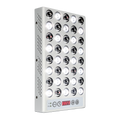
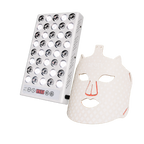
The Resty MARS 400 has two wavelengths: 660 nm red and 850 nm near-infrared, usable separately or together. The MARS 600 to 2000 have nine wavelengths, from 480 nm (blue) to 1060 nm. For all of them, the visible colours pass through clothing worst and near-infrared best. No fabric is a filter with known properties, so uncover the skin you want to reach. You will find all panels in the red light therapy collection.
If you first want to know how red light works, read red light therapy: how it works, benefits and safety.
What still applies when your skin is uncovered?
- Protect your eyes. Wear the protective glasses every session. Why is explained in red light therapy: should your eyes be open or closed?
- Follow the manual. Do not use a panel if you are sensitive to light or take medication that makes you more sensitive to light, if you are pregnant, on open wounds in the area or on skin that was sunburnt in the past two weeks. The full list is in the manual. If in doubt, talk to your doctor first.
- Stop if something feels wrong. Stop if the warmth feels uncomfortable, or if you notice skin irritation or eye discomfort.
- Do not fall asleep. Never use the panel while sleeping.
Frequently asked questions
Does red light therapy work through a T-shirt?
Partly. In measurements with thin cotton, roughly a quarter to a third of near-infrared light (850 nm) got through, and less visible red light (660 nm), especially with a dark shirt. If you want the light on your skin, take the shirt off or move it away from that area.
Do you have to be naked for red light therapy?
No. Only the skin you want to reach needs to be uncovered. You can keep underwear, gym shorts or swimwear on as long as they do not cover that area.
Does infrared light go through clothes?
Near-infrared, such as 850 nm, partly goes through thin clothing. Long-wave infrared, the heat radiation from a heat lamp or from your own body, is mostly blocked by ordinary clothing. That is why your shirt warms up under a heat lamp.
Does a white shirt let more red light through than a black one?
For red light, usually yes: dark dyes absorb a lot of red light. For near-infrared the difference is small. A white shirt does reflect a lot of light, so white is no substitute for bare skin either.
Can you use red light under a blanket or sheet?
Better not. A blanket or sheet is thick or consists of several layers, so little light gets through. Also, no fabric should lie on or against a panel: keep the ventilation openings clear.
Should I use it longer if I keep my clothes on?
No. You do not know how much your clothing blocks, and fabric can heat up. Uncover the area instead and keep to the time and distance in the manual.
Sources
- Jeffery G, Fosbury R, Barrett E, Hogg C, Rodriguez Carmona M, Powner MB. Longer wavelengths in sunlight pass through the human body and have a systemic impact which improves vision. Scientific Reports 15, 24435 (2025). doi.org/10.1038/s41598-025-09785-3
- Dobnik Dubrovski P, Fakin D, Ojstršek A. Cotton woven fabrics as protective polymer materials against solar radiation in the range of 210-1200 nm. Polymers 15(5), 1310 (2023). doi.org/10.3390/polym15051310
- Fuada S, Katz M. Joint optical data and energy transmission through biological tissue in the presence of clothing layers. Results in Engineering (2025). doi.org/10.1016/j.rineng.2025.108090
- Tong JK, Huang X, Boriskina SV, Loomis J, Xu Y, Chen G. Infrared-transparent visible-opaque fabrics for wearable personal thermal management. ACS Photonics 2(6), 769-778 (2015). arxiv.org/abs/1507.04269
- American Academy of Dermatology. Is red light therapy right for your skin? aad.org
- Resty MARS 600-2000 user manual v2.0 (EN/DE/FR/NL). pdf

